
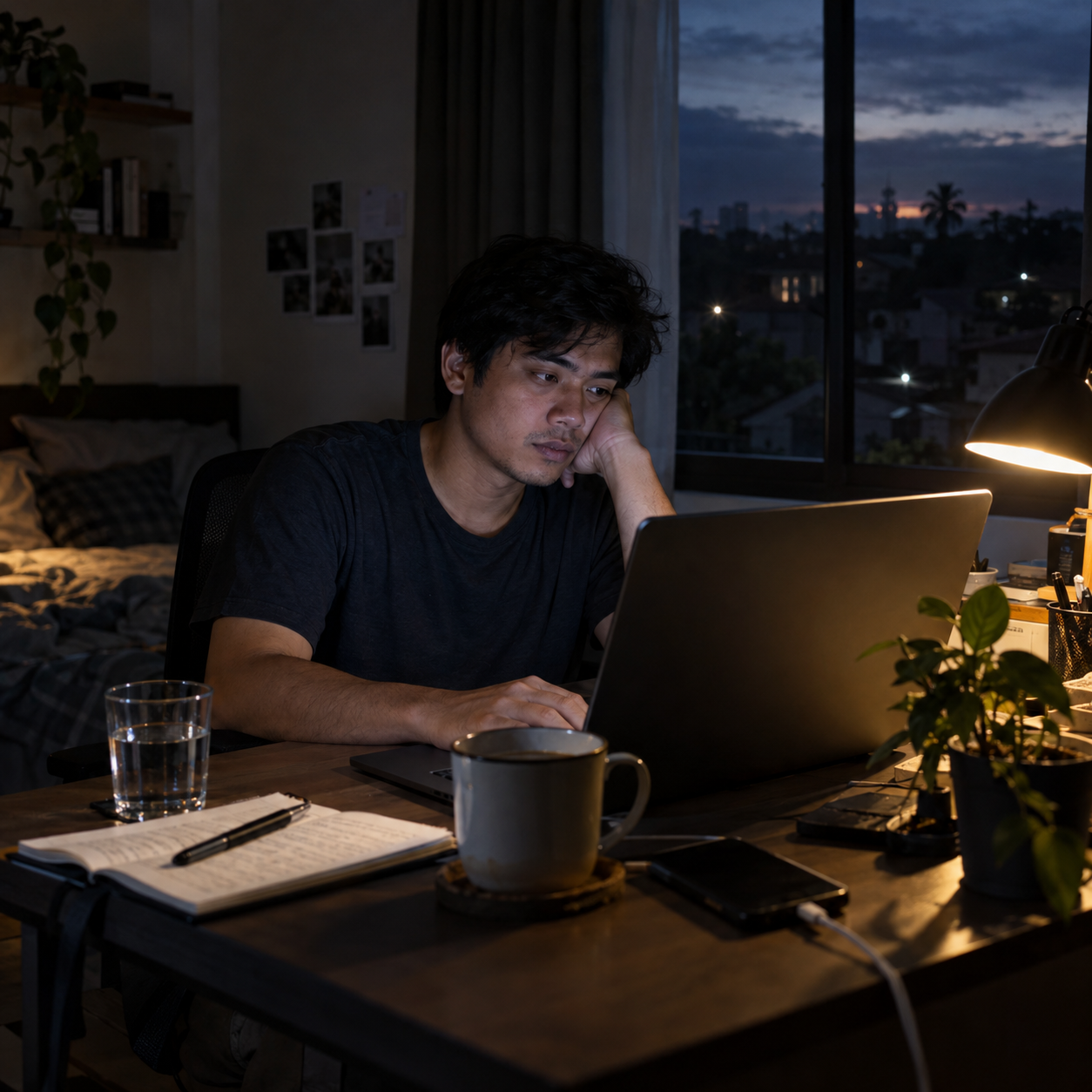
When I got my first night shift opportunity, it felt like a win. I finally had a client, I was earning in dollars, and I was working from home while everyone else was fighting traffic or waiting on the next local job posting to open up.
Honestly, the schedule didn't scare me either. I told myself I'd pulled all nighters before. Cramming for exams, binge watching shows until sunrise, coming home from a night out just as the birds started up. I remember thinking, how different could this really be?
For the first month or so, I was running on pure adrenaline. Everything was new. The client's business, the software, that small fear of messing something up in front of someone I'd never even met in person. That nervous energy kept me upright. Coffee worked. Energy drinks worked. Even the pressure itself felt like fuel.
I'd log off in the morning tired but proud. While my neighborhood was just waking up, parents making breakfast, kids heading to school, the street starting to hum with traffic, I was shutting my laptop and heading to bed, quietly satisfied that I'd made money while the rest of the world slept.
I'll admit, that feeling was intoxicating. I started telling myself I was a night owl by nature. I posted about the perks of remote work: no commute, decent pay, working in pajamas if I wanted to. In my head, it all checked out.
Then month twelve came around, and the adrenaline was gone.
The job wasn't new anymore. The pressure that used to feel exciting just felt like pressure. Coffee didn't hit the way it used to. I'd sleep a full eight hours and still wake up exhausted, and I eventually understood why. Daytime sleep isn't the same as nighttime sleep. Not even close. There's sunlight leaking through the curtains, cars passing, deliveries knocking, family members moving around the house. My body knew the world was awake, even when I was pretending it wasn't.
So my sleep got lighter. I'd wake up to use the bathroom and couldn't fall back asleep. I'd check one notification “real quick” and lose an hour I didn't have to spare. Then the alarm would go off, and I was expected to show up sharp anyway.
This is the part I don't think anyone really talks about.
The toll didn't show up all at once for me. It crept in. I got irritable over small things. I forgot stuff I'd normally never forget. I'd reread the same sentence three times before it made sense. Caffeine stopped being a boost and started being a requirement just to feel like a functioning person.
My schedule stopped lining up with everyone else's life. Appointments landed during the hours I was supposed to be asleep. Family get togethers happened right before my shift started. Friends would invite me out exactly when I needed to rest, and sometimes I went anyway, because I refused to let my whole life shrink down to just work and sleep. My body always sent me the bill for that later.
Slowly, without really noticing, I started trading things away. Sleep for family time. Rest for errands. Sunlight for deadlines. Entire weekends for recovery.
The mental side was its own weight to carry. Working while the rest of the world sleeps can be strangely lonely. At two or three in the morning, it genuinely felt like I was the only person awake on the planet. My client was online, but they weren't really there. My family was a few feet away, but they were dead asleep. I was connected to everyone and completely alone at the same time.
On top of that, I felt this unspoken pressure to act like everything was fine. Remote work is supposed to be the easy option, right? No commute, comfortable clothes, working from my own home. So when I was running on fumes, it felt almost embarrassing to admit it. I'd tell myself other people had it worse. I'd remind myself I needed the paycheck. I worried that asking for a schedule change would make me look ungrateful, or replaceable.
That fear is exactly why I think so many VAs just stay quiet about it.
The industry loves to talk about flexibility, but rarely mentions who's actually doing the flexing. More often than not, it's the Filipino worker rearranging their entire life to match someone else's business hours on the other side of the world. We call it flexibility. Honestly, I've come to see it as sometimes just permanent sacrifice with better branding.
I want to be clear, though. I don't think every night shift is a bad deal, or that nobody can make one work long term. For plenty of people, working nights really is the smarter move. Better pay, fewer distractions, opportunities that simply don't exist locally. But I think we owe it to ourselves to be honest about what the schedule actually costs. A night shift doesn't just shift your hours. It reaches into your sleep, your meals, your relationships, your focus, and the basic texture of everyday life.
If you're on nights, here's what I've learned the hard way. Protecting your health can't be a “someday” project. It has to be part of the job description, right alongside deadlines and deliverables. That means real boundaries around your sleep. A room that's actually dark and actually quiet. Some backbone when it comes to turning down errands, extra meetings, or “just one more client” during hours that are supposed to be yours to rest in.
Above all, it means listening to what your body is already trying to tell you.
I've had to remind myself of a few things along the way. Being exhausted all the time isn't proof that I'm a hard worker. Feeling cut off from my own life isn't just a rite of passage on the way to success. And needing actual rest doesn't make me weak.
In month one, adrenaline convinced me I could keep that pace up forever. By month twelve, my body had a very different opinion, and looking back, it was the more accurate one.
I think a remote career worth having shouldn't depend on how long you can outrun exhaustion. It should give you enough stability to protect the one person actually doing the work.
That person is you. It was me too.
Behind the Screen explores the realities Filipino virtual assistants experience but rarely discuss openly: night shifts, burnout, pressure, and the work it takes to build a career that actually lasts.
Get your copy on Amazon: Behind the Screen ↗